How’s your Upper Body Posture?
With tech use it’s especially important to check in with your upper body posture. As people spend hours a day bent over a screen and keyboard, the head shifts forward, shoulders rotate in and even breathing patterns are altered as the brain is reprogrammed to perceive tech-neck posture as normal. Creating interoceptive awareness is how we can feel the disconnect between our perception of “good posture” and reality.
Interoception is your brain’s perception of your inner body, including the often-unconscious awareness of your heartbeat, digestion, muscles, joints and where you are in space. Your posture is how you hold, carry, and balance your whole body… and it’s all connected.
How you hold your body, molds your body
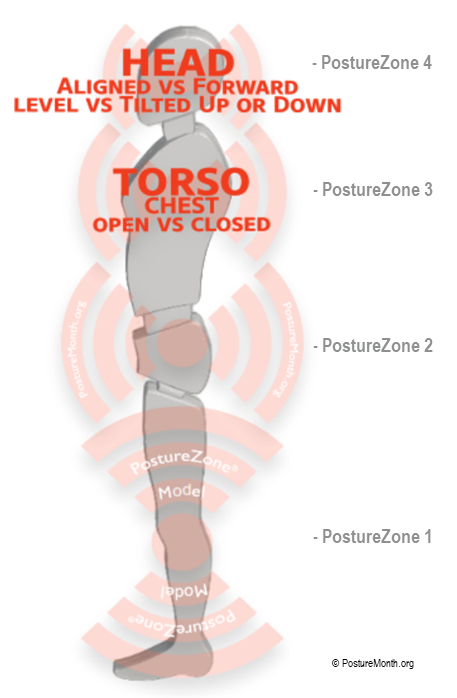
When your internal perception of your body’s movement is different from what your body is actually doing, there’s a disconnect between your internal body perception and external reality. These errors in perception change how you control muscles, forcing your whole body to work slightly differently and less efficiently.
Interoceptive Awareness
Building interoceptive awareness can help reduce the impact of tech-neck or forward head posture, back pain, and other biomechanical body stress. Plus, strengthening your posture reduces body stress to prevent pain as well as improve your overall health! Simply spending a few minutes each day noticing your posture is a great way to boost interoception. You can start by checking your upper body posture using a wall as a tool, focusing on one part of your body at a time.
Upper Body Posture Improvement Exercise
Here’s a simple interoceptive exercise to improve your upper body posture awareness and breathing. It’s called a StrongPosture® Wall Lean.
Step-by-step, focus on:
- STANDING TALL: 1 foot-length from a wall
- PELVIS: Reach back and rest your buttocks on the wall. Feet straight, knees locked.
- TORSO: Lean back. Bring your shoulders to the wall. Keep your chest open, palms forward.
- HEAD Level, eyes looking straight ahead
Next, take 5 slow breaths, focusing on different areas of your body with each breath:
- Breath 1: Keep your head level and press it towards the wall as you exhale.
- Breath 2: Keep your head level and press your shoulders down as you exhale.
- Breath 3: Check that your feet and knees are straight, and your head is still level.
- Breath 4: Make sure your shoulders are still pressed down and press your head towards the wall.
- Breath 5: Lift your head a little higher as you exhale, imagining a balloon lifting it up.
Continue standing tall and take a few more breaths for midday mindfulness and posture break.

POSTURE TIP: Ask a friend to read the cues to you so you can fully focus on each body part’s position in space. Also, if you have posture adaptations or issues, you may find some difficulty with this exercise, so be sure to stay in the pain-free range for where your body is today.
Accurate body awareness is the first step towards better posture, so get Posture Aware. For even more posture improvement, join the 31 days to Stronger Posture Challenge on PostureMonth.org or find a StrongPosture® practitioner for personalized help.
PRACTITIONER TIP: Download the free resource Upper Body Posture Awareness Questionnaire (uPAQ).

The uPAQ is designed to make patients and clients pay closer attention to their posture. By having them rate their head alignment, head tilt, and shoulder symmetry, the uPAQ serves as a proprioceptive and interoceptive exercise, fostering awareness of the subtleties of their own bodies.
- What sets the uPAQ apart is its ability to engage patients on a deeper level.
- With just a simple checkbox exercise, you can spark a fascination about their own posture.
- By adding the physical reality of a posture picture, using any photo app, you can provide more effective education and engagement.